China eSIMs
City eSIMs
Regional eSIMs
China Telecom is one of China’s three biggest mobile carriers and a popular choice for both locals and travelers. It’s especially known for strong coverage across southern China, including cities like Guangzhou and Shenzhen.
In this guide, you’ll learn how much a China Telecom SIM costs, where to buy one, how its coverage compares with other carriers, whether it offers eSIM for tourists, and when a travel eSIM may be the easier option for your trip.
China Telecom provides reliable 4G and 5G coverage across China’s major tourist destinations, including Beijing, Shanghai, Guangzhou, Shenzhen, Chengdu, Xi’an, and Hangzhou.
One area where China Telecom stands out is southern China. Across multiple recent traveler discussions, it’s consistently described as one of the strongest networks around Guangzhou, Shenzhen, and nearby cities.
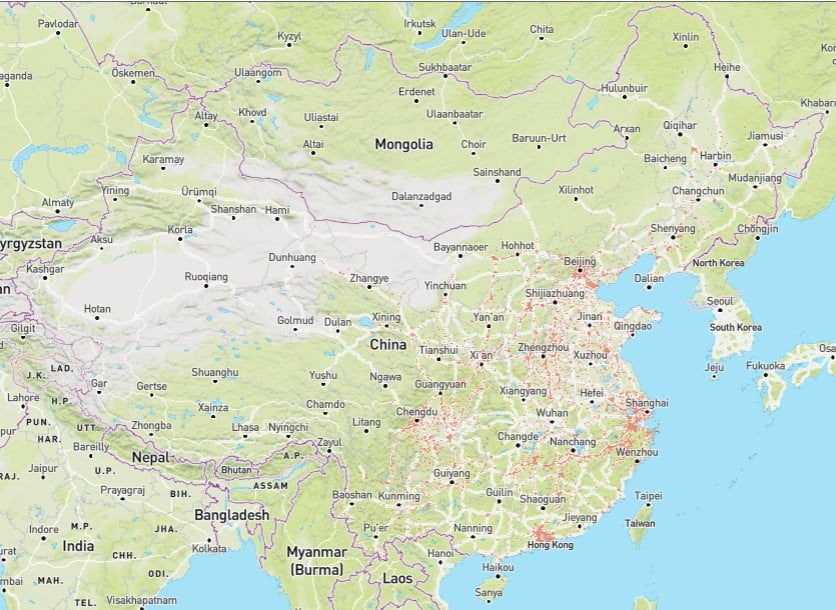
China Mobile is still considered the safest option for remote rural areas, while China Unicom is often viewed as the easiest local SIM for foreign visitors in large northern cities.
If you want to check signal quality for your exact route, nPerf’s live coverage map provides crowdsourced coverage data across mainland China.
| Region | China Telecom |
|---|---|
| Beijing | Excellent |
| Shanghai | Excellent |
| Guangzhou | Excellent |
| Shenzhen | Excellent |
| Chengdu | Excellent |
| Xi’an | Excellent |
| High-speed rail routes | Very good |
| Remote western provinces | More limited than China Mobile |
If your trip is mostly around Guangzhou, Shenzhen, and southern China, China Telecom is one of the strongest local networks. If you’re traveling across multiple regions and don’t need a Chinese phone number, a ChinaeSIM travel eSIM can be the simpler option because it can connect to supported partner networks as you move.
A China Telecom tourist SIM usually costs between 29 RMB and 199 RMB, depending on how much data and how many calling minutes you need. For most short trips, the entry-level plans are enough for everyday navigation, messaging, and social media.
| Data | Voice | Price |
|---|---|---|
| 10 GB | 100 min | 29 RMB (~$4.29) |
| 15 GB | 100 min | 39 RMB (~$5.77) |
| 20 GB | 200 min | 59 RMB (~$8.73) |
| 30 GB | 500 min | 129 RMB (~$19.08) |
| 60 GB | 1000 min | 199 RMB (~$29.44) |
These prices are representative prepaid packages, but it’s worth confirming the latest options at an official China Telecom store when you arrive.
You have three ways to get connected on the China Telecom network: buy a physical SIM at the airport, buy one from an official China Telecom store in the city, or buy a ChinaeSIM travel eSIM online before your trip.
This is the easiest choice if you want a Chinese phone number as soon as you arrive.
China Telecom has official counters in the arrivals areas of major international airports.
For the latest locations and opening hours, see our airport SIM card guide.
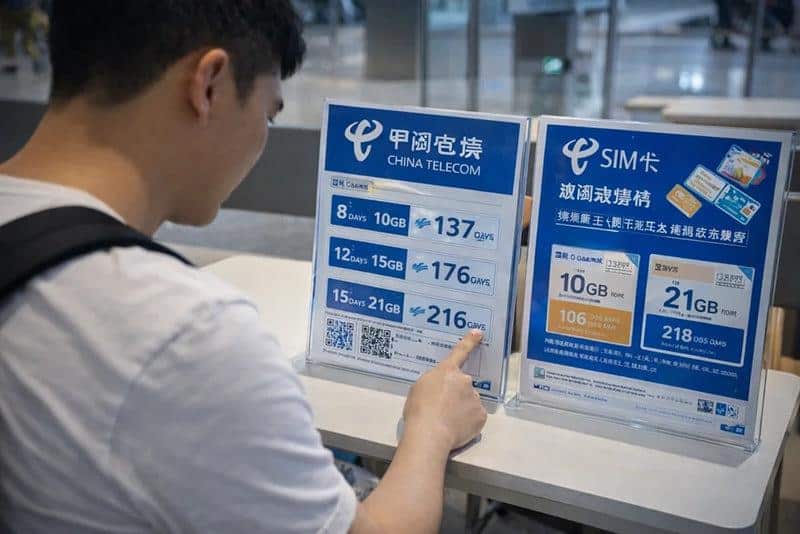
If you’re already traveling in China, visit an official China Telecom (中国电信) store, recognizable by its red-and-blue logo. You’ll usually find these stores in shopping centers and commercial districts across major cities.
The easiest way to find one nearby is to search “中国电信营业厅” in Amap (Gaode Maps), which generally works more reliably than Google Maps inside mainland China.
Our city SIM guides for Beijing, Shanghai, and Guangzhou have more detail on finding a store near you.
Before you visit, bring your original passport. China requires real-name registration for every SIM card, and staff will scan your passport before activating your SIM.

Before You Buy
Before buying a China Telecom SIM, remember two things: you'll need your original passport for real-name registration, and China Telecom's own smartphone eSIM isn't available to foreign tourists. If you prefer to skip the in-store registration process, a ChinaeSIM travel eSIM is usually the easier option.
If you don’t need a Chinese phone number, buying a China Telecom travel eSIM before your trip is usually the most convenient option. You can purchase it online, install it before or after arriving as long as you have an internet connection, and avoid visiting a carrier store altogether.
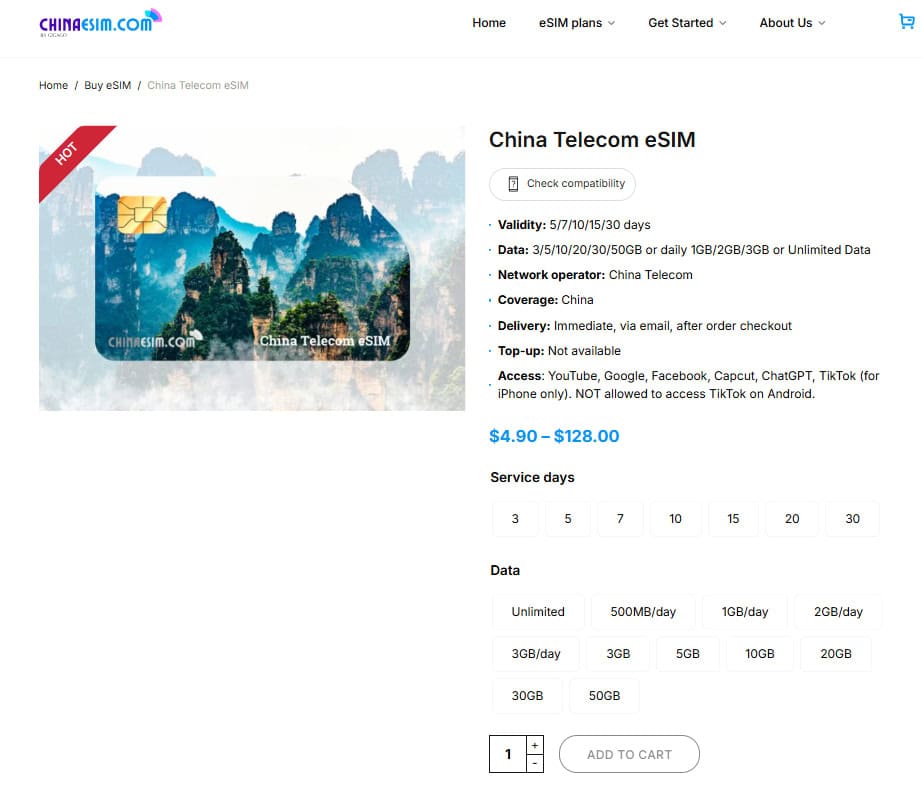
Unlike a local China Telecom SIM, a ChinaeSIM travel eSIM uses international data routing, so Google Search, Gmail, Google Maps, YouTube, WhatsApp, and Instagram usually work without a separate VPN while you’re in China.
No. China Telecom doesn’t offer smartphone eSIMs to foreign tourists. Like China Mobile and China Unicom, it only supports eSIM for local ID holders on a small number of smartwatches, not tourist smartphones.
This is where many travelers get confused. A China Telecom local SIM is different from a ChinaeSIM travel eSIM.
| Feature | China Telecom Local SIM | ChinaeSIM Travel eSIM |
|---|---|---|
| Foreign smartphones | Physical SIM | Yes |
| Smartphone eSIM for tourists | No | Yes |
| Chinese phone number | Yes | No |
| Passport registration | Yes | No |
| Buy before your trip | No | Yes |
A ChinaeSIM travel eSIM uses international data routing instead of a standard mainland China internet exit, which usually allows Google Search, Gmail, Google Maps, YouTube, WhatsApp, and Instagram to work without a separate VPN.
If you’re using an eSIM-compatible phone, check our eSIM Compatibility Guide before purchasing.
Want to skip the airport queue and bypass China’s firewall?
ChinaeSIM eSIM plans connect to the same China Telecom network. It lets you use Google, WhatsApp, Instagram, YouTube right away. Activated online in 5 minutes, no passport registration needed.
Choose a physical China Telecom SIM if you need a Chinese phone number for local services or plan to stay for weeks or months.
Choose a ChinaeSIM travel eSIM if your priority is getting online quickly without visiting a carrier store and usually using Google, WhatsApp, and other global apps during your trip.
| Feature | Physical China Telecom SIM | Travel China eSIM |
|---|---|---|
| Bypasses the Great Firewall | No | Yes |
| Google (Search, Gmail, Maps, YouTube) | Blocked, needs a VPN | Usually works without a VPN |
| Blocked, needs a VPN | Usually works without a VPN | |
| Blocked, needs a VPN | Usually works without a VPN | |
| Where to buy | Carrier store or airport kiosk | Online, before you arrive |
| Activation | In person, with passport | Remote, before or after arrival |
| Chinese phone number | Yes | No |
| Voice calls | Yes | Data-only on most plans |
To activate and use a China Telecom SIM card, follow these steps:
If you want to top up for additional calls + data:
No. A standard China Telecom SIM follows mainland China’s internet restrictions, so Google Search, Gmail, Google Maps, YouTube, WhatsApp, and Instagram require a VPN. A ChinaeSIM travel eSIM usually lets these apps work without a separate VPN because it uses international data routing.
No. China Telecom’s domestic eSIM service isn’t available for tourist smartphones. International visitors who want an eSIM typically use a travel eSIM instead.
China Telecom is generally strongest in southern China, especially around Guangzhou, Shenzhen, and parts of the southwest.
Bring your original passport. Staff will register the SIM under your name as part of China’s real-name registration process.
Yes. If you plan to rely on a VPN with a local SIM, it’s much easier to download and configure it before entering mainland China.
Get Started
Useful Guide