China eSIMs
City eSIMs
Regional eSIMs
A SIM card at China airport counters is one of the most common ways tourists get connected upon landing. Most international airports in China including Beijing Capital (PEK), Beijing Daxing (PKX), Shanghai Pudong (PVG), Shanghai Hongqiao (SHA), Guangzhou Baiyun (CAN), and Shenzhen Bao’an (SZX), have carrier kiosks from China Mobile, China Unicom, or China Telecom in the arrivals hall.
This guide covers exactly where to find SIM card counters, what you need to buy one, how much it costs, and what to watch out for at each major airport.
Want to skip the airport queue? Get your China eSIM online and activate it before your flight!
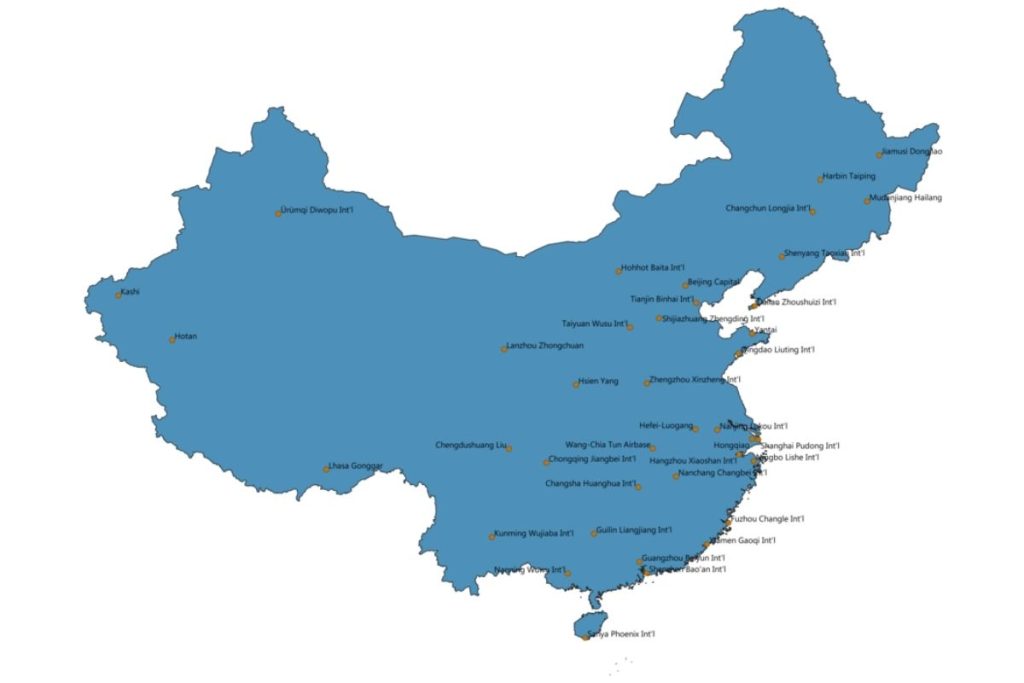
China boasts several major international airports that offer SIM card services for tourists. Here are some of the most prominent ones:
Beijing Capital International Airport, serving the nation’s capital, is one of the busiest airports in the world. It is well-equipped to cater to the needs of international travelers, including the provision of SIM cards.
Beijing Capital Airport has China Unicom and China Mobile counters in the Terminal 3 arrivals hall, just past customs and baggage claim. China Unicom is the most popular choice for tourists at PEK due to wider English-language support.
Check out our detailed guide on how to get a tourist SIM Card at Beijing Airports.
Daxing is China’s newer mega-airport in China. SIM card counters are located on the arrivals level (B1). Daxing has fewer carrier counters than PEK. Lines can be longer during peak hours, especially during the Golden Week in China.
Guangzhou Baiyun International Airport is the main hub for southern China and a major transit point for Southeast Asian connections. Here, you can find SIM card kiosks and counters operated by various telecom companies, making it convenient to purchase a SIM card as soon as you land.
Tip: Guangzhou airport staff tend to speak Cantonese and Mandarin. English support is limited compared to Beijing and Shanghai, so prepare your request in writing or use a translation app.
Shanghai Pudong International Airport is one of the busiest airports in mainland China and a major gateway for international travelers. SIM card kiosks are in both Terminal 1 and Terminal 2 arrivals halls.
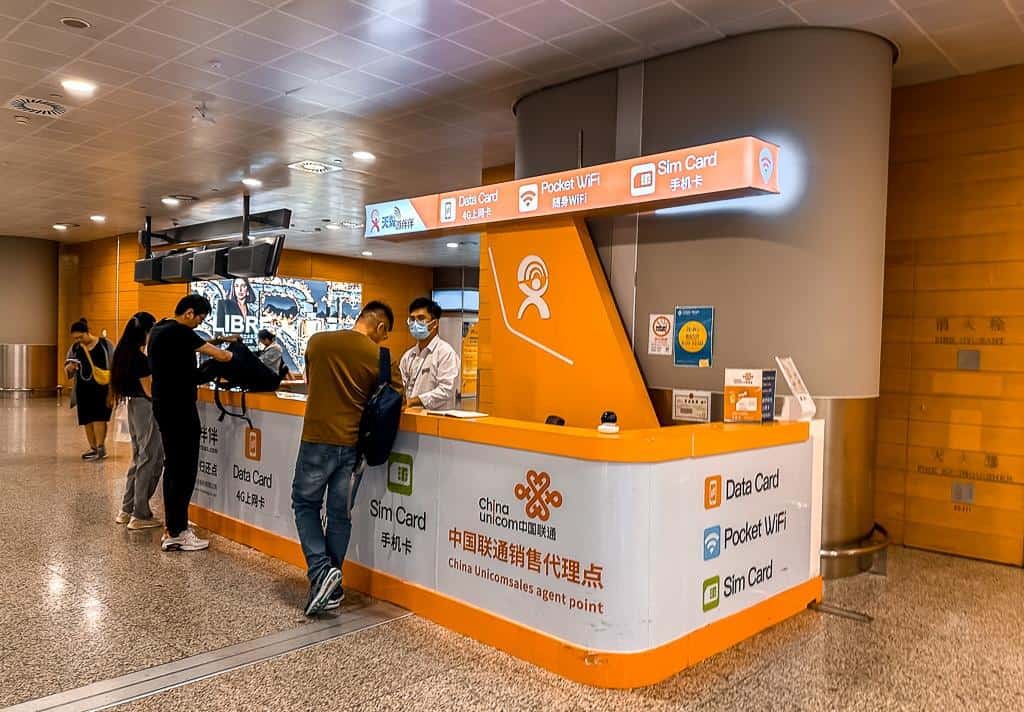
Arriving in Shanghai? Discover where to buy SIM Card at Shanghai Pudong Airport.
Hongqiao primarily serves domestic flights but handles some international routes (mainly to Japan, Korea, and Southeast Asia). SIM card options at Hongqiao are more limited than Pudong. If arriving internationally, Pudong (PVG) has better tourist SIM availability.
Shenzhen Bao’an International Airport features modern facilities serving the tech-savvy city of Shenzhen. It is a common entry point for travelers coming from Hong Kong. You may find vending machines that dispense SIM cards. These machines offer a quick and convenient way to purchase a SIM card without having to interact with a salesperson. However, the selection of plans and options may be limited.
For connectivity in Shenzhen: Check out our SIM Card guide for Shenzhen Bao’an International Airport.
At smaller international airports like Chengdu Tianfu (TFU), Xi’an Xianyang (XIY), Kunming Changshui (KMG), and Hangzhou Xiaoshan (HGH), SIM card availability varies:

To ensure a smooth process when purchasing a SIM card at a Chinese airport, it’s essential to have the following items ready:
Your passport is the primary form of identification required when buying a SIM card in China. Make sure to have your original passport with valid China visa or entry stamp, as the telecom service providers will need to verify your identity and record your passport details.
While some SIM card vendors may accept Visa/Mastercard, it’s always safer to carry a sufficient amount of cash in Chinese Yuan (CNY) to avoid any hassles. Check with your bank or credit card provider about any potential foreign transaction fees.
Online transfer method such as WeChat Pay and Alipay are widely accepted if you already have them set up.
Before purchasing a SIM card, ensure that your mobile device is unlocked and compatible with the cellular networks in China. Most modern smartphones support the necessary frequency bands, but it’s always better to double-check with your service provider or the SIM card vendor.
While many SIM card vendors at major airports have staff proficient in English, having a translation app or phrasebook can be helpful, especially if you encounter language barriers or need to clarify specific details about the SIM card plans.
Airport SIM prices are typically 20–40% higher than buying the same plan at a downtown carrier store. You’re paying for the convenience. Below are the estimated prices for a 30-day tourist SIM card at major airports in China.
| Airport | Carrier | Data | Validity | Approximate Price (USD) |
|---|---|---|---|---|
| Beijing PEK | China Unicom | 10 GB | 30 days | $15 |
| Beijing PEK | China Unicom | 20 GB | 30 days | $22 |
| Shanghai PVG | China Unicom | 20 GB | 30 days | $20 |
| Shanghai PVG | China Mobile | 10 GB | 30 days | $15 |
| Guangzhou CAN | China Unicom | 10 GB | 30 days | $12 |
| Guangzhou CAN | China Mobile | 20 GB | 30 days | $18 |
| Shenzhen SZX | China Unicom | 10 GB | 30 days | $14 |
For most tourists landing at Beijing, Shanghai, or Guangzhou, China Unicom is the recommended carrier. It offers the clearest tourist plans, the most English-speaking staff at airport counters, and reliable 4G speeds in all major cities.
This is the single biggest issue tourists discover after buying a regular SIM card at the airport: China’s Great Firewall (GFW) blocks most Western apps and websites. Many don’t realize until they’re already in a taxi leaving the airport.
What is blocked on a regular China SIM Card:
What works on a China SIM Card:
Some travelers plan to use a VPN to bypass the GFW. However:
Since 2023, all SIM card purchases in China require facial recognition scanning. This is a government regulation and cannot be bypassed. Your face scan is linked to your passport and SIM number. The SIM Card staff will take your photo, then spend about 15–30 minutes for document check, registration and setup.
If the downsides above concern you: the Great Firewall blocking your apps, airport queues, counter hours, facial recognition, or language barriers, there’s an alternative that solves all of them.
A China eSIM from Chinaesim.com lets you:
Ready to skip the airport queue?
ChinaeSIM offers China eSIM plans with built-in Great Firewall bypass — full access to Google, WhatsApp, and all social media. Activate online before your flight, land connected. Plans starting from $4.90.
The cost of a SIM card in China can vary depending on the telecom provider, data allowance, and validity period. Generally, you can expect to pay between 100 CNY and 300 CNY (approximately $15 to $45 USD) for a tourist SIM card with a decent amount of data and validity period.
While it is possible to use your home country’s SIM card in China, it may incur hefty roaming charges, and the data speeds may be slower. Purchasing a local SIM card is generally more cost-effective and provides better connectivity.
The setup process for a SIM card in China is generally quick and straightforward. Once you’ve purchased the SIM card, the vendor will assist you in installing it and activating the plan. The entire process typically takes 10-15 minutes.
Yes, most telecom providers in China offer options to top up your SIM card’s data allowance or extend its validity period. You can typically do this through the provider’s app, website, or by visiting one of their physical stores or authorized resellers.
No. Airport SIM counters accept cash (CNY) and sometimes international credit cards. However, having exact change in CNY is recommended as card acceptance is inconsistent.
Staying connected while traveling in China is essential, and purchasing a local SIM card at the airport is one of the most convenient ways to ensure reliable internet access. By following this guide, you’ll be well-prepared to navigate the process of obtaining a SIM card at major Chinese airports, enabling you to stay connected throughout your journey. Whether you opt for a physical SIM card or an eSIM solution, having a local data plan will undoubtedly enhance your travel experience in China.
Get Started
Useful Guide